

The ACAA
If flying within the domestic USA, or on an American airline carrier, the flight crew must comply with the American Air Carrier Access Act, or the ACAA. Anyone traveling with a disability should familiarize themselves with the ACAA, as these are your rights on any flight or within any airport (in the US.)
The full verbiage of the act can be found at this link here, but here are the main points:
- Entitlement to luggage for medical supplies, including assistive devices, which is not charged as luggage, and is excluded among baggage limitations. It is recommended (by me and the DOT) that any medical supplies, including medications and anything related to administration (syringes, tubing, etc.) be packed in carry-on luggage. These items are important to keep with you, and may get lost if checked luggage goes missing.
- Entitled to seat assigned next to yours if a caregiver is needed. An extra seat is not included in the ticket fee; each seat needs to have a purchased ticket. However, the seats can be next to each other.
- Entitlement to a certain kind of seat- including with a mobile armrest, or a “bulkhead” seat with more legroom. These are given to passengers who need the mobile armrest to transfer in and out of the seat; and who have a fusion or another reason for being unable to bend their leg(s) for a medical reason.
- Similarly, airlines may not deny a passenger from choosing any type of seat, including the exit row (but they can check the ability to perform the emergency functions required with sitting there.)
- Also similarly, airlines may not require that a disabled passenger have a travel companion. However, if an airline insists on having a companion/caregiver for the disabled passenger’s safety, the second ticket must be free (the airline is not allowed to charge for a second ticket.)
- Storage of a manual wheelchair on a plane with 100 seats or more. This doesn’t include rigid chairs unfortunately, as the closets are too small. But if yours is the only wheelchair onboard a flight meeting these criteria, they need to offer room for whatever will fit in the storage space- I often store my wheels, clothing guards, and my cushion, for example, while my frame gets stored below.
- I always ask for a seat for my rigid frame though. If there are empty seats, my frame can sit in a seat like person and be strapped in with a seatbelt. They don’t always accommodate me like this (and they’re not forced to by law), but I always ask.
- Entitlement to storage of mobility aids and any power equipment, including batteries- even if it needs to go below in the cargo hold. If the battery to a powered mobility aid isn’t immediately identified as safe or airplane compliant, the airline must offer a way to safely store the battery.
- Airlines may not limit the amount of passengers on any given flight with a disability.
- On a flight greater than 60 seats, a mobility compliant bathroom must be onboard, with an aisle chair available for anyone who needs it.
- On a plane with capacity for greater than 19 passengers, at an airport with greater than 10,000 annual flights, a mechanical lift or ramp must be available for boarding and deplaning if the plane is not docked on a level loading platform (tarmac.)
- Regardless of the plane size, airline staff must provide assistance with boarding, deplaning, and making connections, as applicable.
- Anyone self-identifying as disabled (visually or not) must be allowed to pre-board before the general passenger population.
- Airlines may not require advanced notice of a disabled passenger traveling on any given flight. However, I find that if I reserve myself as having a wheelchair on board, my chair is given priority for storage. The airlines don’t have to guarantee storage on the plane, and I believe it’s “first come, first served,” but on most airlines there is a place to reserve the need for disability service when booking a ticket. This option helps both the passenger and the airline crew be more prepared for the flight needs that day.
- Airlines must offer assistance if disability accommodations are not related to mobility limitations- such as hearing or vision.
- Oxygen must be on offered onboard by the airlines, but they are allowed to charge for it if they are supplying. They may not deny a passenger’s supply of oxygen or charge extra for it onboard. (as it is considered a medical device.)
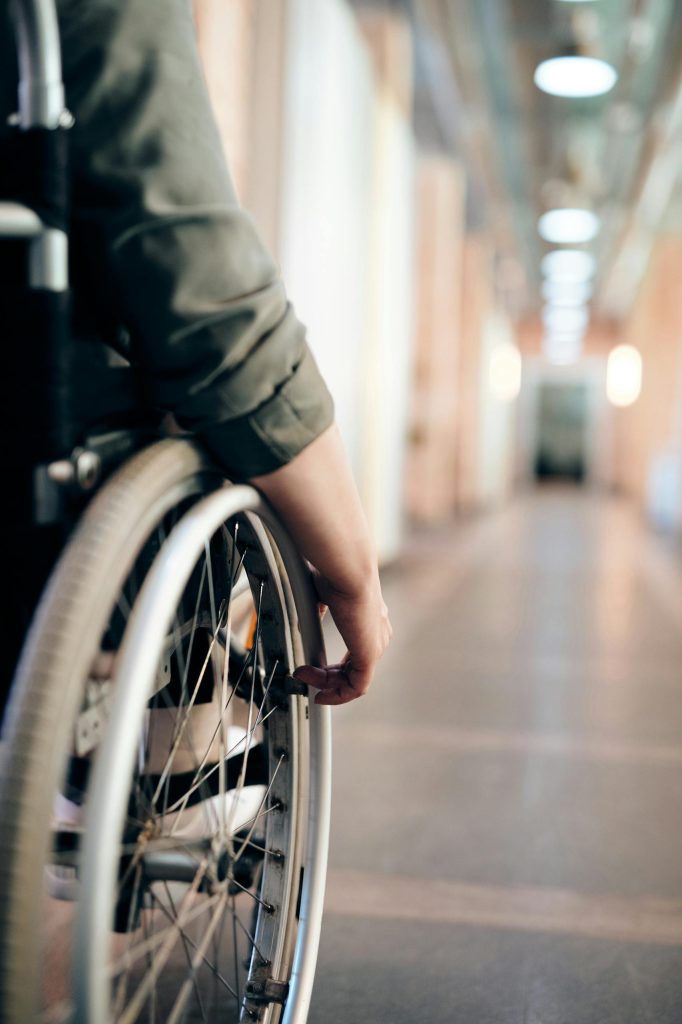
Flying With a Mobility Aid
I made a handy slide deck on tips for traveling with a mobility aid, but I will type out my recommendations below. If you’d like my free handout of tips for flying with a mobility aid for easier reference, please click here.
I would also add a bonus tip: buy a big (6″ or bigger) carabiner so you can pull wheeled luggage behind your chair. It helps quite a bit, especially for those of us with manual wheelchairs!
- If help is needed from curbside to the gate, a “gate pass” may be offered to one non-ticketed person to accompany the disabled passenger. This gate pass must be requested at the check-in counter of any airline, and it is up the airline’s discretion to offer a gate pass. The non-ticketed person must have a photo ID, and go through the regular TSA line, unless both the non-ticketed person and the disabled passenger have PreCheck clearance.
- Disabled passengers are allowed to go to the front of the security checkpoint (TSA) line. Verbal self-identification may be needed if the passenger is not visually disabled.
- I highly recommend TSA PreCheck for anyone traveleing with a mobility aid, especially if at all ambulatory. The TSA officers are not required to do a “pat-down” examination if the passenger has PreCheck clearance. Especially if ambulatory, the passenger can walk through a scanner (Often a metal detector, not a full body scan where the person has to hold their arms above their head for 90 seconds.) After walking through a scanner, the officers will tell the passenger where to wait as they examine the mobility aid, and often provide a substitute cane or chair. They will quickly swipe down your aid and have it back to you, usually in under 3-5 minutes. It’s so much of a more humane experience. Many credit cards will cover PreCheck or Global Entry (which includes PreCheck) fees, so getting the clearance is worth it.
- Check in at the flight gate as soon as able (DOT recommends at least an hour.) Tell them whether you need an aisle chair or not. Ask them to store your aid onboard, (if able and that’s what you want), though the request will need to be made again on the plane.
- Take several photos and video of your aid, from multiple angles, as you are able, before boarding. If there is damage to your chair/aid, you may need to have proof it wasn’t there before the flight.
- I would highly recommend laminating an information sheet to attach to your aid if it needs to be stored in the cargo hold. If possible, talk directly to the staff who will be loading it, and tell them how best to handle and store it. The sheet should include: mobile parts that stay attached, battery type, how to move the chair with the power off, how/if it folds, and every piece of contact information you are comfortable putting on there.
- Take every moving part off of your aid before storage. On a wheelchair, that includes at the minimum: seat cushion, arm rests, clothing guards, bags, and the controller/joystick if moveable. There are mixed reviews as to whether you should be the one folding your chair or not, some people say they have less damage on their chair if they leave it unfolded. Again, if you can talk to the loading crew, I recommend asking them. Turn your battery off now.
- If you need the aisle chair, talk them through your transfering process.
- If able to store your aid onboard, communicate as well as you can with the flight crew. Ask them where best to store your aid or medical supplies in an overhead bin. Ask again once onboard, if you’d like to store your wheelchair frame onboard.
- After the flight: do NOT deplane, or let them transfer you onto the aisle chair, until you have confirmation your chair is available on the tarmac. Once you are off of the plane, you may not get back on, and they may not help you!
- Inspect your aid immediately for damage, and get help as soon as you see someone. Every airline has a Compliance Officer with whom you can submit a damage report, or complaint as needed.
- They are required to help you up the ramp or provide a lift to transfer from tarmac to terminal. Don’t be afraid to ask for help.

Airport Staff Transportation Within the Airport
Airport staff are required by law to accommodate any passenger unable to walk from the security checkpoint to their gate, complimentary. However, the staff are not required to provide a wheelchair unless it is needed (meaning, they can provide a cart instead.) Thus, it is important to tell the staff at the check-in counter what your needs are, when you get to the airport.
Airport transportation staff are required to bring you to the bathroom on request, on the way to the gate. Don’t be afraid to ask if you think you may need it!
I have seen mixed reviews on tipping airport transportation staff. Do what is comfortable for you, but please don’t feel obliged to tip the staff. They are providing a service which is required. This concept is vastly different from tipping the wait-staff at a restaurant. Transportation within the airport is not a luxury, it’s a necessity.